
The Day Camille No Longer Needed to Be Found
 The Day Camille No Longer Needed to Be Found
Part 1 — Rain Over Croix-Rousse
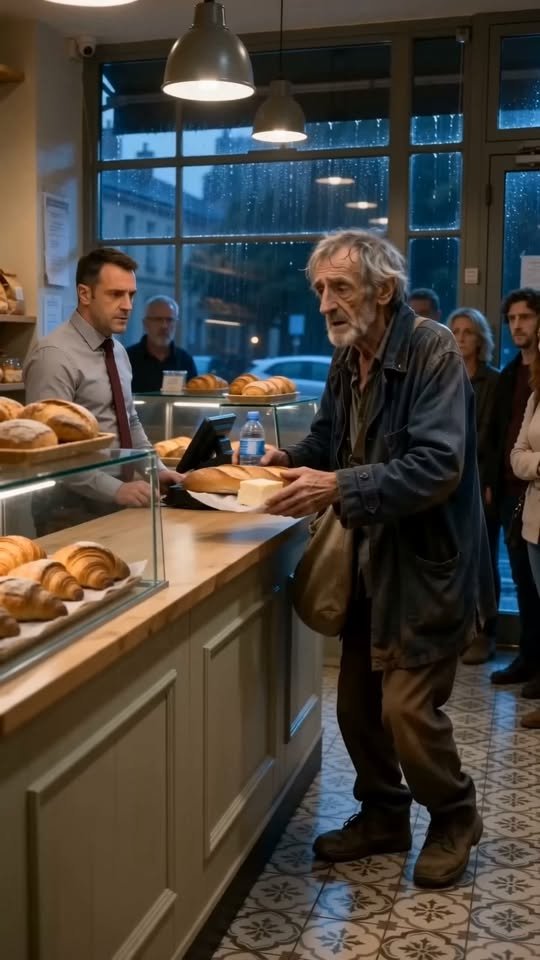
The rain in Lyon that evening wasn’t falling in heavy drops; it was more like a cold, persistent mist that settled over the cobblestones of the Croix-Rousse neighborhood. Inside the bakery, the warmth smelled of toasted flour and brown sugar. Nineteen-year-old Camille stood behind the counter, carefully arranging the last batch of baguettes before closing shop.
Outside, the street was nearly empty, except for a figure huddled under the awning of the bakery. It was an elderly woman, her coat torn at the elbow, clutching a small canvas bag as if it held her entire life. She was shivering, not just from the cold, but from exhaustion.
Camille’s mother, Claire, who had spent twenty-seven years building this small cooperative bakery from scratch, noticed her first. Without saying a word, Claire wrapped a warm sandwich in butcher paper, poured a hot cup of coffee into a paper cup, and walked out into the rain.
Camille watched through the steamed-up window. She saw her mother hand the food to the old woman, speak softly for a few moments, and then return inside, wiping the raindrops from her forehead.
“Who was that, Mom?” Camille asked, handing her a dry towel.
Claire smiled gently, though her eyes carried a distant look. “Someone who remembered what it feels like to be hungry, Camille. And someone who reminded me why we opened this place in the first place.”
Part 2 — The Torn Coat
The old woman’s name was Éléonore. Over the next few weeks, she became a quiet, almost invisible presence around the neighborhood. She never asked for money, nor did she ever beg. Every evening around closing time, she would sit on the bench across from the bakery.
Each night, Claire or Camille would step outside with a fresh loaf of bread, a warm pastry, or a bowl of soup. In return, Éléonore offered no dramatic story of fallen wealth or forgotten nobility—just small, quiet conversations.
“People always look for clues, little one,” Éléonore told Camille one evening, her voice rough like dry leaves. “They look at my torn coat and think there is a grand mystery, a hidden fortune, or a secret past. But life isn’t a movie. Sometimes, a person just makes bad choices, loses their footing, and finds themselves outside in the rain.”
Camille listened intently. At nineteen, she had spent years searching for grand meaning, analyzing every detail of her life, wondering if she was meant for something larger. But standing there under the streetlamp, listening to Éléonore, she realized something profound: reality was far simpler, and much more human.
Éléonore wasn’t a secret heiress. She was simply an old woman who had made mistakes, lost what she had built, and was trying to live out her final days with whatever dignity she could preserve.
Part 3 — The Unspoken Debt
As the months passed, Éléonore’s health began to decline. The harsh winter of Lyon took its toll on her fragile frame. Claire and Camille didn’t hesitate; they helped arrange a modest, warm room for her through a local community program and visited her regularly.
One afternoon, sitting by Éléonore’s bedside, Camille asked her mother a question that had been lingering in her mind for months.
“Mom, why did you help her so instantly that first night? You didn’t even know who she was.”
Claire looked at her daughter, her hand resting on Camille’s. “Twenty-seven years ago, before you were born, I lost everything, Camille. I was stranded in this very city, penniless and afraid. A stranger at a train station bought me a ticket and a warm meal. They didn’t ask for my name, and they didn’t ask for repayment. They just said, ‘Pass it on when you can.’“
Claire paused, looking out at the gray sky. “Helping Éléonore wasn’t about solving a mystery or becoming a hero. It was simply paying back a debt to a stranger who helped me almost three decades ago.”
Part 4 — The Day Camille No Longer Needed to Be Found
Those words stayed with Camille forever. The appearances. The signs. The desperate urge to turn every small detail of life into a grand revelation. The truth was often less spectacular—and much simpler.
Éléonore passed away peacefully on a quiet autumn morning at the age of eighty-six. In her tiny room, there was no secret fortune or complicated will. There was only a handwritten note left on her nightstand, addressed to Claire and Camille. In it, she simply thanked them for giving meaning to her final years and for proving that past mistakes do not have to define how a story ends.
On the day of the funeral, Claire and Camille stood alongside a few bakery workers. There was no large crowd, but there was a deep, sincere sense of peace. Watching her mother’s calm face, Camille finally understood that the circle was complete. A twenty-seven-year-old wound had been healed—not by a financial miracle, but by an ordinary act of kindness worth just a few euros.
Today, when new employees step inside the bakery in Croix-Rousse, they notice a small wooden plaque mounted near the counter. It bears just two words: Share Purely.
And sometimes, when a customer hesitates over the price of a sandwich on a cold, rainy Lyon evening, the young person behind the counter doesn’t just look at the register. They remember that a simple gesture can stitch up the torn coat of the past—and turn a simple bakery into a place where no one needs to be lost to finally be found.