
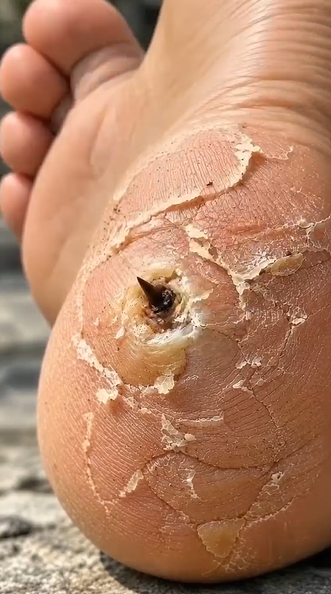
😱 A Sharp Dark Object Hidden Inside a Thick Heel Callus — What Could It Be?
The surrounding skin looks hardened and begins peeling away in several layers. But what could be hiding beneath this thick skin?
Could it be a deeply embedded thorn, a wooden splinter, or a painful foot condition such as a plantar wart?
Although the appearance is dramatic, the exact cause cannot be confirmed from a photograph alone. Understanding the possibilities is important before attempting any treatment.
What Could Be Hiding Beneath the Heel?
One possibility is an embedded foreign object, such as a thorn, splinter, or small piece of wood.
These objects can enter the sole when someone walks barefoot or steps on something sharp. When the object becomes trapped beneath thick heel skin, it may create a painful opening and make walking uncomfortable.
Another possibility is a plantar wart, also known as a verruca. These growths develop on the soles of the feet and can become covered by thick, hardened skin.
Plantar warts sometimes contain tiny black dots, which are small blood vessels. They can cause discomfort when pressure is applied during walking.
A third possibility is a corn or callus. These develop when repeated pressure or friction causes the outer layer of skin to become unusually thick.
Important: The dark pointed structure in the image cannot be confidently identified as a thorn, splinter, or another material without professional examination.
Why Does the Heel Develop Thick, Cracked Skin?
The heel supports much of the body’s weight during everyday activities. Repeated pressure and friction can cause the skin to produce extra layers of protective tissue.
Several factors can contribute to this problem:
- Wearing tight or poorly fitted footwear.
- Walking barefoot on rough surfaces.
- Standing for long periods.
- Dry skin and reduced moisture.
- Repeated pressure on the same part of the heel.
When thick skin develops around an injury or another skin condition, it may make the affected area harder to examine.