
Tiny Brown Barrels on a Tree Branch? Here’s What They Really Are

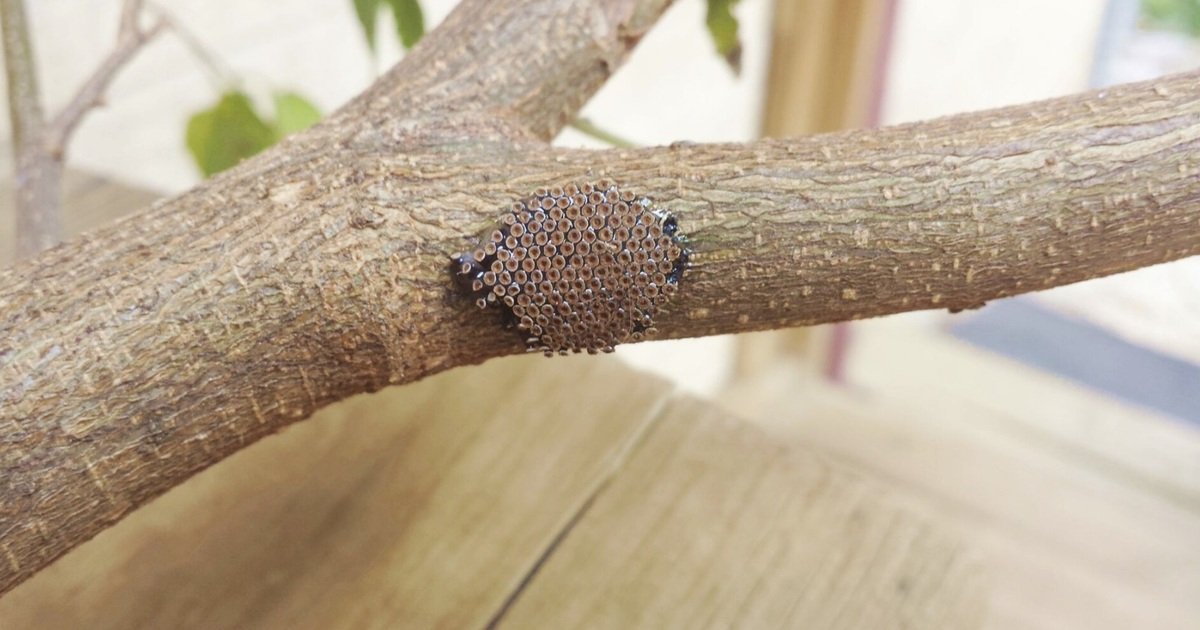
Those tiny brown barrels stacked on a twig like a mini honeycomb are almost certainly wheel bug eggs. People describe them a dozen ways. Cracker barrels for fairies. Little bottles glued on end. A patch of alien eggs. All the same thing: a cluster of cylindrical brown egg cases laid by a female wheel bug. Here’s the twist most people miss. If the tops of those barrels look open or cracked, the eggs have already hatched, and the babies are long gone. What you’re staring at is the empty shell.
What Wheel Bug Eggs Actually Look Like
Up close, each egg looks like a little brown bottle standing upright, with a paler, rounded cap on top. They sit glued together side by side in a tight, six-sided pattern. That’s exactly why so many people reach for the word honeycomb. The whole arrangement sits flat against the bark, looking almost manufactured rather than grown.
I found my first batch on the rough bark of a crepe myrtle. I genuinely thought a kid had pressed something craft-related onto the trunk. They don’t look soft or jelly-like the way we expect bug eggs to. They look like dozens of tiny clay pots arranged by someone with too much patience.
The female lays them in fall. A single cluster can hold anywhere from several eggs to more than a hundred, all packed into one neat patch. You’ll find them on small twigs, branches, bark, and sometimes fence rails or other solid outdoor objects. The brown color blends right into the wood, so a lot of people only notice them while pruning or tidying up sticks.
Why the Tops Are Open (Hatched vs. Waiting)
Wheel bug eggs overwinter. The female lays them in autumn, they sit tight through the cold months, and in many areas they hatch around April. The nymphs tend to come out all at once, or close to it, so the cluster stays sealed one day, and open doors fill the honeycomb the next.

That’s the real tell. If the little barrels have rounded, intact caps, the eggs are still waiting. If the tops look cracked or popped open, the nymphs have already emerged and scattered to go hunt.
The empty shells don’t fall off right away either. They stay glued to the bark, keeping that tidy hexagonal shape long after everyone’s moved out. So when you find a cluster in late spring or summer with open tops, you’re basically looking at an abandoned apartment building.
Meet the Wheel Bug, a Garden Predator
The adult that lays these eggs is a strange-looking insect called Arilus cristatus. It’s a large gray assassin bug. You can spot one by the raised crest on its back. The crest looks exactly like half a cogwheel or a tiny circular saw blade. Nothing else in the yard looks quite like it.
And it’s one of the good ones. The wheel bug is a predator that hunts caterpillars, beetles, and other soft-bodied insects, including plenty of species that chew up garden plants. It grabs prey with its front legs and feeds through a stout beak.
There’s just one brood per year. The adults mate in autumn, the well-fed female lays her clusters of brown eggs, and then she dies before winter. Her eggs carry the next generation through to spring. So that cluster on your branch is less a problem and more a handoff, the whole life cycle packed into one small patch of bark.
Are Wheel Bug Eggs Dangerous to People, Pets, or Plants?
Short version: the eggs won’t hurt your tree, your garden, your kids, or your dog. Wheel bugs don’t feed on plants at any stage. They’re meat eaters. The eggs sitting on your branch aren’t damaging the wood. The nymphs that hatch out hunt other insects, not your tomatoes.
The one practical caution is about the adults, not the eggs. A grown wheel bug can deliver a genuinely painful bite if you handle it or trap it against your skin. It’s not aggressive and won’t chase you down, but it will defend itself. So the rule is simple: look, don’t grab. The egg cluster itself is harmless to touch, but if you see the big gray adult nearby, admire it from a respectful distance.
Should You Remove Them? What to Do If You Find a Cluster
Leave them. That’s the honest answer. A cluster of wheel bug eggs is free pest control waiting to hatch. Scraping it off bark throws away future predators. Those predators would have worked your garden for you.
I’ll admit I nearly made that mistake myself. The first time I found a cluster, I wanted to scrub the odd-looking patch off the bark. I hadn’t even figured out what it was yet. It just looked like something that shouldn’t be there. I’m glad I stopped to look it up first. It felt a little like almost tossing out something useful before reading the label.

There’s no need to spray, scrape, or treat anything. If the cluster sits on a twig you genuinely have to prune, snip the twig. Set it somewhere else in the yard instead of crushing it. The eggs will still hatch wherever you tuck them. This kind of leave-it-be approach is the same quiet observation that makes you notice odd features around the house you’d normally walk right past.
How to Tell Them Apart From Similar Egg Clusters
Three things together give wheel bug eggs away. Look for the upright barrel shape, the tight hexagonal packing, and the brown color sitting right on a twig or bark. Not many other insects produce that exact combination out in the open.
A few readers guessed mason bees, which is a reasonable thought but not the match. Mason bees nest inside existing holes and hollow tubes and seal the ends with mud. They don’t build exposed stacks of little barrels on the surface of a branch.
Other insects lay foamy or frothy egg masses that dry into a spongy, tan blob with no visible individual eggs. Those look nothing like the crisp, geometric bottle-cluster of a wheel bug. If you can count distinct upright cylinders packed in a six-sided grid, you’ve almost certainly got wheel bug eggs.
The Case for Leaving Them Alone
A quiet cluster of brown barrels on your maple or crepe myrtle is a good sign. It means your yard is the kind of place a predator insect chose to raise the next generation. Come spring, the nymphs march off to hunt, and all that’s left behind is the empty honeycomb of shells, still glued to the bark, holding its shape long after the tenants are gone.