
😱 Giant Tick-Like Parasite Attached to the Ear: The Importance of Immediate Removal
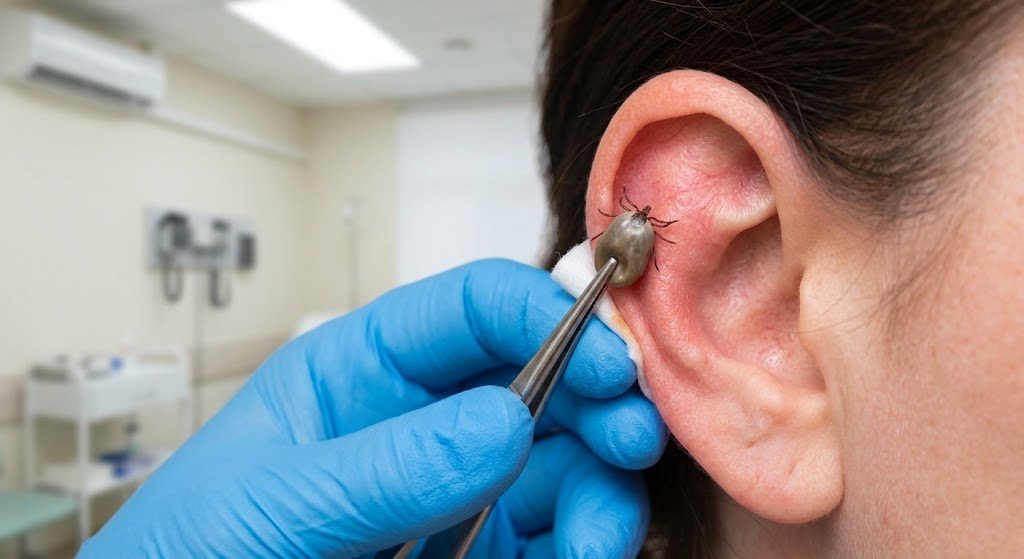
The image shows a large, dark, tick-like organism firmly attached to the skin near the ear, while a gloved professional carefully works to remove it with forceps.
Its unusual size and appearance can be alarming. However, a photograph alone cannot confirm the exact species or even prove with certainty that the organism is a tick. If it is an attached tick, though, prompt and careful removal is important because ticks can transmit disease-causing organisms.
🕷️ Why Do Ticks Attach Around the Ear?
Ticks can attach to many parts of the body and may be particularly easy to miss around the ears, hairline, and other hidden areas. CDC guidance specifically recommends checking in and around the ears after spending time outdoors in areas where ticks may be present.
Ticks can be encountered in grassy, brushy, or wooded environments, and they may also be carried into homes by animals or on clothing.
⚠️ Why Should an Attached Tick Be Removed Quickly?
The CDC recommends removing an attached tick as soon as possible rather than waiting for symptoms or delaying removal. Some ticks can transmit pathogens while feeding.
After a tick exposure, possible symptoms of tick-borne illness include fever, chills, headache, fatigue, muscle or joint pain, and rash. Symptoms can develop days or weeks after the exposure.
🧤 What Is the Correct Way to Remove a Tick?
For an accessible attached tick, CDC recommends using clean, fine-tipped tweezers and grasping the tick as close to the skin’s surface as possible.
Pull straight upward with steady, even pressure. Avoid twisting or jerking because the mouthparts can break off and remain in the skin. Afterward, clean the bite area and your hands thoroughly.
Because the lesion in this image is located close to the ear and appears unusually large, professional assessment may be appropriate, particularly if removal is difficult or the area is painful or inflamed.
🚫 What You Should NOT Do
Do not try to make an attached tick detach using petroleum jelly, heat, nail polish, or other substances. These methods are not recommended and may increase the risk of problems during removal.
5 Essential Safety Tips
1. Remove attached ticks promptly.
Don’t deliberately leave a tick attached.
2. Use fine-tipped tweezers.
Grip as close to the skin as possible and pull steadily upward.
3. Never burn or smother the tick.
Avoid heat, petroleum jelly, and nail polish.
4. Check the entire body.
Look carefully around the ears, hair, scalp, underarms, waist, and behind the knees.
5. Watch for symptoms.
If fever, rash, headache, fatigue, or muscle/joint pain develops after a suspected tick bite, contact a healthcare professional and mention the exposure.
🔎 Final Takeaway
A large tick-like organism attached near the ear can certainly look frightening, but the most important steps are simple: identify the organism when possible, remove it safely and promptly, clean the area, and monitor for symptoms.
And if multiple ticks are found or the attachment is difficult to remove, professional medical assistance is the safest choice.
Medical Disclaimer: This article is based only on the visible features of the supplied image. It cannot confirm the identity of the organism or diagnose a tick-borne infection. A qualified healthcare professional should evaluate unusual, extensive, or persistent attachments.