
😱 Giant Tick-Like Parasite Removed From the Ear: Why Immediate Care Matters

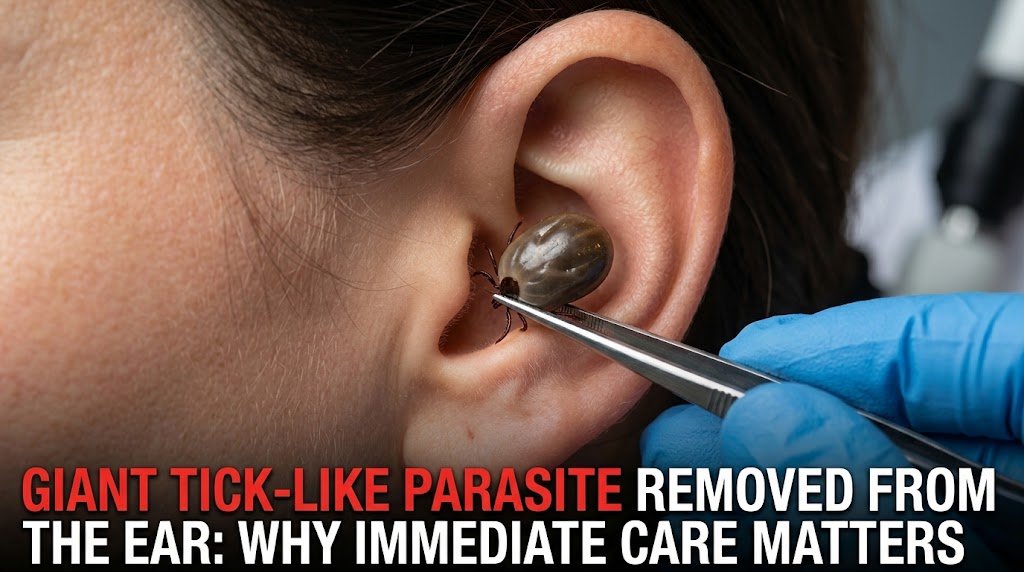
A shocking close-up image shows a large, dark, tick-like organism lodged near the outer ear while a gloved professional attempts to remove it with forceps. Its unusual size and rough appearance make the scene especially alarming.
Although the image cannot confirm the exact species, it highlights an important health concern: a parasite attached to the skin near the ear should be handled carefully to prevent injury and possible infection.
🔎 What Could This Organism Be?
The object resembles a tick, a small parasite that attaches to a host and feeds on blood. Ticks can attach to different parts of the body, including the ears and hairline, and some species can transmit disease-causing germs. However, an image alone cannot establish the organism’s identity.
⚠️ Why Is Safe Removal Important?
An attached tick should be removed promptly. Pulling or squeezing it incorrectly may leave mouthparts embedded in the skin, while some tick species can transmit infections during feeding.
Because the ear is a delicate area, professional assistance is especially sensible if the organism is deeply embedded, located inside the ear canal, or difficult to remove safely.
🏥 How Should an Attached Tick Be Removed?
For an accessible tick attached to ordinary skin, health authorities recommend using clean, fine-tipped tweezers to grasp it close to the skin and pull upward with steady, even pressure. Avoid twisting or jerking it. Clean the bite area and your hands afterward.
Do not use heat, petroleum jelly, nail polish, or other substances to force the tick to detach. If it is inside the ear canal or cannot be removed easily, seek medical assistance rather than probing with tools.
🛡️ 5 Safety Tips to Remember
- Check your ears and hairline: Look for attached ticks after spending time outdoors.
- Remove ticks promptly: Use an appropriate method for accessible skin, without crushing the organism.
- Avoid harsh home remedies: Never use heat, nail polish, or petroleum jelly to detach a tick.
- Inspect your body and pets: Other ticks may be present on the body, clothing, or animals.
- Watch for symptoms: Seek medical advice if you develop fever, a rash, headache, unusual fatigue, or muscle and joint pain after a tick bite.
✅ Final Takeaway
A large tick-like organism attached near the ear is a situation that deserves careful attention—not risky home extraction. Prompt, safe removal and awareness of possible symptoms can help reduce complications.
Medical Disclaimer: This article is for educational purposes only. The image does not confirm that the object is a tick or establish any diagnosis. A healthcare professional can assess the organism, the bite site, and whether further treatment is needed.